New research from McKinsey & Company spotlights how closing the healthcare worker shortage gap could eliminate 7 percent of the global disease burden and add $1.1 trillion to the global economy.
"The healthcare worker shortage isn't a distant threat. It's a present and growing crisis. Yet in boardrooms and policy circles, it rarely commands the urgency of a supply chain disruption or a market downturn. It should."
"This is a silent emergency undermining our health, our workforce productivity, and our economic resilience."
Key Data Points from McKinsey Research
Closing the healthcare worker shortage adds up to 189 million years to life and $1.1 trillion to the global GDP in 2030.
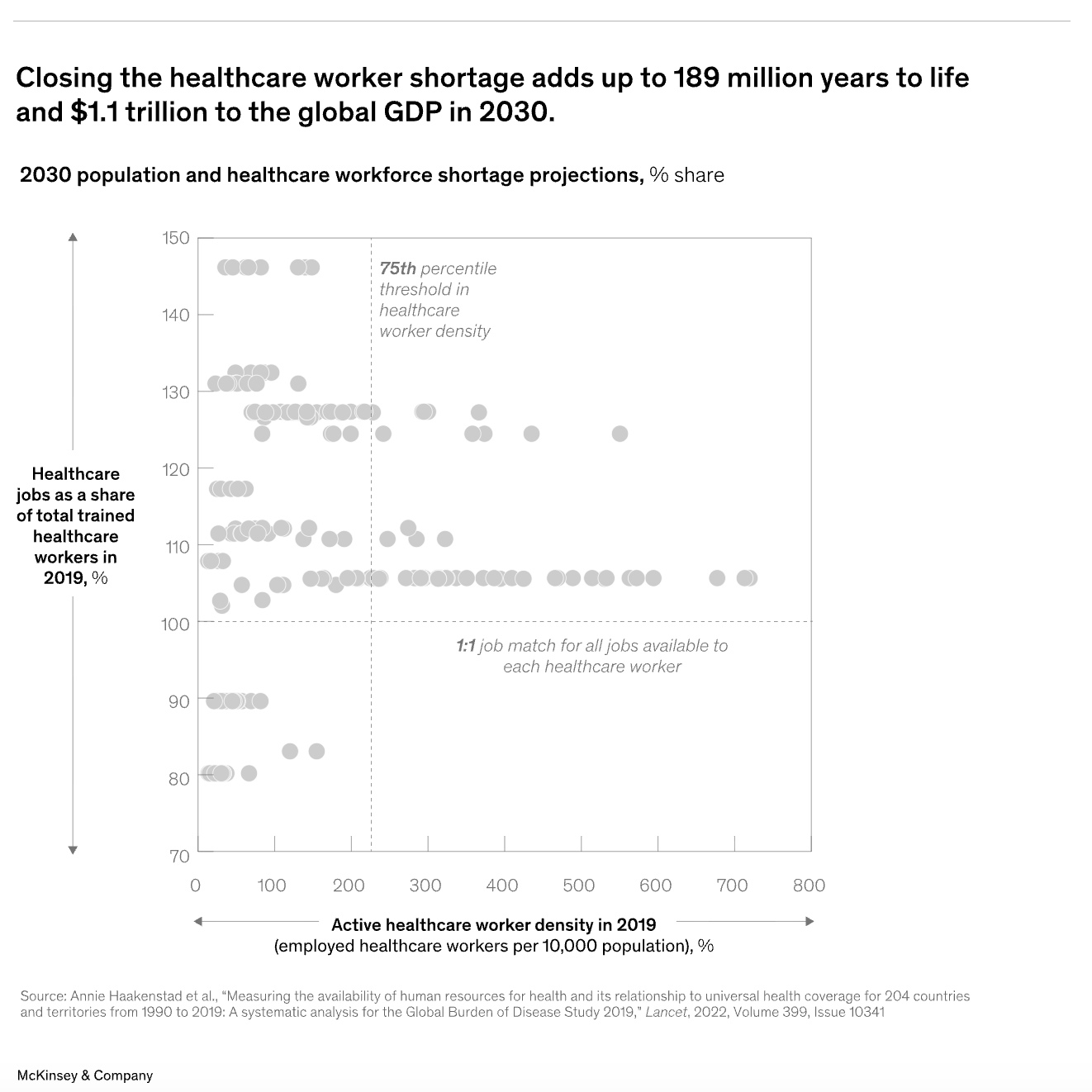
Source: Annie Haakenstad et al., "Measuring the availability of human resources for health and its relationship to universal health coverage for 204 countries and territories from 1990 to 2019: A systematic analysis for the Global Burden of Disease Study 2019," Lancet, 2022, Volume 399, Issue 10341
Two Critical Reports from McKinsey & Company
Leading global research on the healthcare workforce crisis and the urgent need for automation
Heartbeat of Health: Reimagining the Healthcare Workforce of the Future
Comprehensive analysis revealing that traditional hiring won't solve the 10 million worker shortage by 2030. Automation and AI must free the equivalent of 2 million additional full-time workers to close the gap.
Read the full reportRethink 2025: Tackling the healthcare worker shortage
"What's needed now isn't incrementalism. It's bold, targeted investment and system-level redesign. Every innovation that overlooks the frontline healthcare workforce is a missed opportunity and a strategic failure. Every unfilled role compounds the risk. If health underpins every aspect of economic and human capital, then the real question is: How decisively will each region act to build the healthcare workforce it needs, not someday, but now?"
Read the full briefWhat Sidekick Robotics Is Doing
McKinsey's research makes clear that traditional hiring alone cannot close the 10 million worker gap by 2030. Automation and AI must free the equivalent of 2 million full-time workers to address the shortage.
At Sidekick Robotics, we're working to contribute to this solution by automating repetitive, physically demanding tasks in healthcare environments, starting with hospital laundry and logistics.
Our Approach
Sidekick 1.0 is a mobile, intelligent robot designed to handle laundry workflows in care environments. It autonomously navigates, loads, folds, and delivers linens, creating an end-to-end solution that can save hours per shift.
We start with laundry because it's high-frequency, high-impact, and universally needed across healthcare communities. By automating this physically demanding workflow, we aim to help extend the capacity of existing staff.
Our goal: To help healthcare organizations address the workforce capacity challenge highlighted in McKinsey's research by automating physical tasks, allowing healthcare workers to focus on patient care.
Learn More About Our Approach
PART 1: STORY
Our Origin Story: Why Robotics for Caregiving
Learn why we founded Sidekick Robotics and how we're addressing the healthcare labor crisis through AI-powered physical automation.
PART 2
The Next Chapter: Building for the Economy of Motion
How we're thinking about the broader platform opportunity and expanding beyond healthcare to transform physical automation across industries.
References
- McKinsey Health Institute, Heartbeat of Health: Reimagining the Healthcare Workforce of the Future, https://www.mckinsey.com/mhi/our-insights/heartbeat-of-health-reimagining-the-healthcare-workforce-of-the-future
- McKinsey & Company, Rethink 2025: Tackling the healthcare worker shortage, https://www.mckinsey.com/~/media/mckinsey/email/rethink/2025/10/2025-10-08d.html
About Sidekick Robotics
Sidekick Robotics is creating the AI Sidekick for Physical Work, robots that learn and perform the complex tasks that keep hospitals and care communities running. We're tackling the healthcare labor shortage by reducing burnout, turnover, and rising costs, so healthcare workers can focus on what matters most: patients.
Media Contact: founders@sidekickrobotics.ai